Illegal Recording and Penalty Provisions
Under the Protection of Communications Secrets Act (통신비밀보호법), no one may censor mail, intercept telecommunications, provide communication confirmation data, or record or listen to private conversations between others that are not open to the public, except as provided by this Act, the Criminal Procedure Act, or the Military Court Act. However, there are cases in which exceptions are recognized as prescribed by law. Accordingly, such acts are deemed illegal.
A person who, in violation of the law, censors mail, intercepts telecommunications, or records or listens to private conversations between others that are not open to the public, as well as a person who discloses or divulges the contents of such communications or conversations, may be subject to imprisonment of not less than one year and not more than ten years, together with suspension of qualifications for not less than five years.
Whether Wiretapping Is Illegal
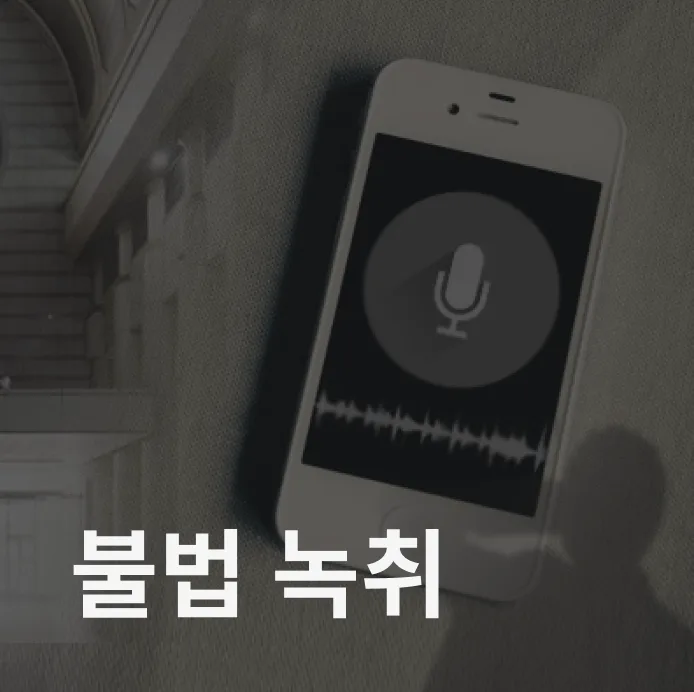
Secretly recording another person's conversation is illegal. This is referred to as wiretapping, and it includes secretly recording other people's conversations, the contents of meetings, and telephone calls. When people think of wiretapping, they generally imagine eavesdropping on secret meetings using high-tech equipment, but the law defines any act of recording another person's conversation without consent as illegal wiretapping and punishes it severely. No one may record or listen to private conversations between others that are not open to the public, and a violation may be punishable by imprisonment of not less than one year and not more than ten years, together with suspension of qualifications for not more than five years.
However, it is not illegal where the person making the recording was a party to the conversation. The Protection of Communications Secrets Act makes it illegal to secretly record another person's conversation, but if the person recording is directly participating in the conversation, doing so is not illegal even without obtaining the other party's consent. Therefore, if matters that could be used as evidence in litigation are being mentioned in a spoken exchange or over the phone, it may be helpful to record the call or conversation in case of any eventuality.
Illegal Recording and Self-Defense
Illegal recording is generally prohibited by law, but in certain situations its legal permissibility may be discussed as part of self-defense. For example, this may apply where the victim of a crime records the criminal conduct in order to protect themselves. In such cases, the purpose and necessity of the recording become important factors in the legal assessment.
Self-defense is an act undertaken to repel a present and unlawful infringement of one's own or another person's legal interests, and it is provided for in Article 21 of the Korean Criminal Act. For self-defense to be recognized, the defensive act must be carried out in an urgent and unavoidable situation. In other words, the imminence of the infringement and the necessity of the defense become important criteria for judgment.
For example, where a victim of domestic violence records a violent situation in order to protect themselves, the recording may constitute illegal recording, but there is a possibility that it could be recognized as self-defense in a legal assessment. In this case, the recording may serve as important evidence proving the violent conduct, and if the victim's purpose of seeking their own safety through it is acknowledged, the court may judge it to be self-defense.
A similar rationale may also apply where an employee makes a recording to prove wrongful conduct or criminal acts within a company. In this case, if the recording serves as important evidence to expose organized corruption, the court may recognize it as part of self-defense.
Recording to Gather Evidence of Child Abuse by a Teacher
Child abuse by a teacher is a very serious social problem, and gathering evidence to prove it is important. In particular, parents or guardians often record a teacher's abusive conduct in order to protect a child's physical and emotional safety. Could this pose a legal problem?
Recording to gather evidence of child abuse may be legally recognized in that it is necessary to protect the child's rights and interests. Article 17 of the Child Welfare Act (아동복지법) provides regulations to prevent and punish child abuse, and gathering evidence is essential for this purpose. Therefore, where a parent or guardian records a teacher's abusive conduct for the safety of the child, this is highly likely to be recognized as a legitimate act for the protection of the child's rights and interests.
For example, where a teacher at a school continuously subjects a student to verbal and physical abuse, a parent may attempt to make a recording in order to prove such abusive conduct. This recording can become important evidence that concretely proves abuse that would be difficult to establish based on the child's testimony alone. Through such a recording, the court can confirm the fact of the teacher's abuse and take appropriate legal measures.
As another example, where there is a child who requires special education and a teacher treats such a child unfairly, if a parent gathers evidence through a recording, this can serve as important material proving the child's special need for protection. In such a case, the recording is highly likely to be recognized as a legitimate act for the protection of the child's rights and interests.
In this way, illegal recording may be recognized as a legal exception in special situations such as self-defense or the gathering of evidence of child abuse. This can occur within the scope of what may exceptionally be permitted, when the law functions as an important means of protecting individuals' rights and interests and realizing social justice. Even in such cases, however, it is important to comply with legal procedures and standards, and its legitimacy may be recognized according to the court's judgment.