What is the offense of bodily injury?
The offense of bodily injury set out in Article 257 and Article 258 of the Korean Criminal Act is as follows.
Article 257 (Bodily Injury, Bodily Injury to Lineal Ascendant)
(1) A person who inflicts bodily injury upon another shall be punished by imprisonment for not more than 7 years, suspension of qualifications for not more than 10 years, or a criminal fine not exceeding KRW 10 million. <Amended Dec. 29, 1995>
(2) A person who commits the offense under paragraph 1 against his or her own or his or her spouse's lineal ascendant shall be punished by imprisonment for not more than 10 years or a criminal fine not exceeding KRW 15 million. <Amended Dec. 29, 1995>
(3) An attempt to commit the offense under the preceding two paragraphs shall be punished.
Article 258 (Aggravated Bodily Injury, Aggravated Bodily Injury to Lineal Ascendant) (1) A person who inflicts bodily injury upon another and thereby endangers the victim's life shall be punished by imprisonment for not less than 1 year but not more than 10 years.
(2) A person who, by inflicting bodily injury, causes another to suffer disability or an incurable or hard-to-cure disease shall be punished in the same manner as in the preceding paragraph.
(3) Where a person commits the offense under the preceding two paragraphs against his or her own or his or her spouse's lineal ascendant, the person shall be punished by imprisonment for not less than 2 years but not more than 15 years. <Amended Jan. 6, 2016>
What counts as bodily injury?
There is some academic debate over the definition of bodily injury.
The first view covers cases that impair the bodily integrity of the victim,
and the second view covers cases that impair physiological function.
According to Supreme Court precedent, both of these cases appear to be taken into account.
Sentencing guidelines for bodily injury
<Ordinary bodily injury>
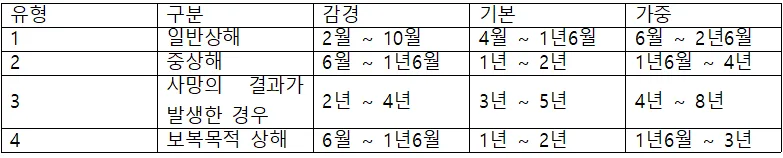
| Category | Mitigating factors | Aggravating factors | |
| Special sentencing factors | Conduct | Where the bodily injury was inflicted with willful blindness (dolus eventualis) Minor injury (types 1 and 4) Where there are circumstances particularly worth considering with respect to the degree of participation in the offense Where the victim also bears substantial responsibility for the occurrence of the offense or the aggravation of the harm Where the resulting death was not caused by the defendant's direct conduct (type 3) |
Where the offender led or directed the commission of the offense Where the offense was committed by displaying the collective force of a group or a crowd, or while carrying a dangerous object (except where the offense group of 2. special bodily injury or repeat-offense bodily injury applies) Where the offense targeted unspecified or numerous victims, or was committed repeatedly over a considerable period Serious injury (types 1 and 4) Instigation of a subordinate A blameworthy motive for the offense (excluding type 4) Where the offense involves obstruction of official duties A cruel method of committing the offense A victim vulnerable to the offense |
| Offender/Other | A person with a hearing or speech disability Diminished mental capacity (not attributable to the offender) Voluntary surrender or whistleblowing Victim's wish not to punish or substantial recovery of the harm (including deposit in court) |
Where the offense constitutes a child abuse crime committed by a person obligated to report child abuse under Article 7 of the Act on Special Cases Concerning the Punishment of Child Abuse Crimes Where the offender is a habitual offender Repeat offense of the same kind |
|
| General sentencing factors | Conduct | Passive participation | Where 2 or more persons committed the offense jointly A premeditated offense |
| Offender/Other | Diminished mental capacity (attributable to the offender) Genuine remorse No prior criminal record Considerable recovery of the harm (including deposit in court) |
||
Sentencing guidelines for special bodily injury
<Special bodily injury>

| Category | Mitigating factors | Aggravating factors | |
| Special sentencing factors | Conduct | Where the bodily injury was inflicted with willful blindness (dolus eventualis) Minor injury Where there are circumstances particularly worth considering with respect to the degree of participation in the offense Where the victim also bears substantial responsibility for the occurrence of the offense or the aggravation of the harm |
Where the offense targeted unspecified or numerous victims, or was committed repeatedly over a considerable period Serious injury (excluding the special aggravated bodily injury type) A victim who is a lineal ascendant Instigation of a subordinate A blameworthy motive for the offense Where the offense involves obstruction of official duties A cruel method of committing the offense A victim vulnerable to the offense |
| Offender/Other | A person with a hearing or speech disability Diminished mental capacity (not attributable to the offender) Voluntary surrender or whistleblowing Victim's wish not to punish or substantial recovery of the harm (including deposit in court) |
Where the offense constitutes a child abuse crime committed by a person obligated to report child abuse under Article 7 of the Act on Special Cases Concerning the Punishment of Child Abuse Crimes Where the offender is a habitual offender |
|
| General sentencing factors | Conduct | Passive participation | A premeditated offense |
| Offender/Other | Diminished mental capacity (attributable to the offender) Genuine remorse No prior criminal record Considerable recovery of the harm (including deposit in court) |
||
What is special bodily injury?
Special bodily injury is defined in the Korean Criminal Act as follows.
Article 258-2 (Special Bodily Injury) (1) A person who commits the offense under Article 257 (1) or (2) by displaying the collective force of a group or a crowd, or while carrying a dangerous object, shall be punished by imprisonment for not less than 1 year but not more than 10 years.
(2) A person who commits the offense under Article 258 by displaying the collective force of a group or a crowd, or while carrying a dangerous object, shall be punished by imprisonment for not less than 2 years but not more than 20 years.
(3) An attempt to commit the offense under paragraph 1 shall be punished.
In other words, special bodily injury is defined by the use of a dangerous object or by a number of people.
A dangerous object here might bring to mind a weapon such as a knife, but depending on the circumstances it could also be a soju bottle or a brick.
One point to note is that special bodily injury carries no criminal fine as a sentencing option.
That said, because a case may be classified as either special bodily injury or ordinary bodily injury depending on how the circumstances are interpreted, it is advisable to consult an expert.
Criminal procedure for the offense of bodily injury
1. Investigation
2. Settlement with the victim
3. Indictment
4. Criminal mediation
5. Criminal trial
6. Application for a compensation order
Civil procedure for the offense of bodily injury
1. Civil mediation
2. Small claims adjudication
3. Civil action for damages
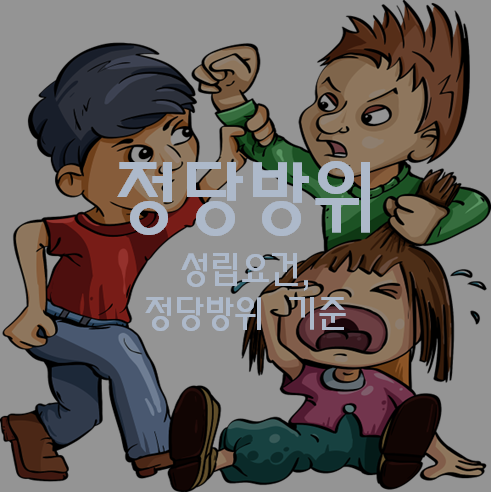
Self-defense
Self-defense is defined in Article 21 of the Korean Criminal Act
(1) An act performed to defend one's own or another person's legal interest (法益) against a present unjust infringement shall not be punished where there are reasonable grounds for it.
(2) Where the defensive act exceeds reasonable limits, the punishment may, depending on the circumstances (情況), be mitigated or remitted.
(3) In the case under paragraph 2, where the act was performed at night or in some other situation of unrest out of fear, alarm (驚愕), excitement, or panic, the person shall not be punished.
For self-defense to be recognized here, all five conditions must be met: ‘present’, ‘unjust infringement’, ‘one's own or another person's legal interest’, ‘an act performed to defend’, ‘reasonable grounds’.
Among the precedents on self-defense, there is a ruling that the commonly assumed scenario in a fight, namely ‘I struck first, so it is self-defense’, was not recognized as self-defense.