Can You Be Charged With Drunk Driving Off Public Roads?
Driving under the influence in places other than public roads can still lead to criminal punishment. Under Article 2 of the Korean Road Traffic Act (도로교통법), a "road" means any place open to the passage of the general public, which includes roads, parking lots, roads within apartment complexes, and any other place the public can travel through. Accordingly, drunk driving in a parking lot or on a road within an apartment complex can also be subject to punishment.
The criminal punishment for drunk driving applies equally whether the driving takes place on a public road or off it. If you are caught driving under the influence, you may face criminal penalties such as a criminal fine or imprisonment depending on your blood alcohol concentration. Even when drunk driving occurs off public roads, the danger it poses is no different from drunk driving on a road, so legal punishment cannot be avoided.
Administrative dispositions such as the revocation or suspension of a driver's license can also apply to drunk driving that takes place off public roads. The Road Traffic Act provides that, in cases of drunk driving, an administrative disposition may be imposed regardless of whether the location is a road. Therefore, if a driver is caught drunk driving in a parking lot or within an apartment complex, that driver may face not only criminal punishment but also an administrative disposition such as the revocation or suspension of their driver's license.
For example, if someone is caught drunk driving in an apartment parking lot, the police will proceed with criminal punishment for violating the Road Traffic Act. At the same time, procedures will be initiated to impose an administrative disposition on that driver's license. This is based on Article 44 of the Road Traffic Act (prohibition of drunk driving) and Article 93 (revocation and suspension of a driver's license, etc.). Accordingly, even when drunk driving is detected off public roads, such as in a parking lot, the driver may have their license revoked or suspended.
Under Article 44 of the Road Traffic Act, drunk driving becomes subject to punishment when the blood alcohol concentration is 0.03% or higher. In addition, under Article 93, a driver caught drunk driving may have their license revoked or suspended for a certain period. This applies equally to drunk driving that takes place off public roads.
If you commit drunk driving off public roads, you can be subject to both criminal punishment and an administrative disposition. This covers parking lots, roads within apartment complexes, and every other place the public can travel through, and drunk driving in such places is met with the same legal sanctions as drunk driving on a road. You therefore need to be careful never to drink and drive off public roads, and above all, you should never get behind the wheel after drinking.
Up until about ten years ago, drunk driving on private property such as a parking lot was not punishable as a drunk driving offense. However, given the risk of accidents involving personal injury and property damage, many argued consistently that drunk driving should be punished even when it occurs off public roads. Eventually, in response to this criticism, the National Assembly amended the Road Traffic Act so that drunk driving could be punished even in places other than public roads.
Under the amended Road Traffic Act, a person caught drunk driving on private property that is not a public road, such as a parking lot, will find it difficult to avoid punishment if their blood alcohol concentration is 0.03% or higher. However, separate from the criminal punishment for drunk driving, unlicensed driving (무면허 운전) on private property is not punishable, and drunk driving off public roads is not subject to license suspension or revocation. Therefore, if you have received an administrative disposition after being caught drunk driving on private property, there is ample room to contest it.
In addition, most instances of drunk driving on private property involve driving for the purpose of parking. If you can adequately explain and make the case for such circumstances, there is a possibility of reducing the severity of the criminal punishment as well.
Refusing a Breathalyzer Test
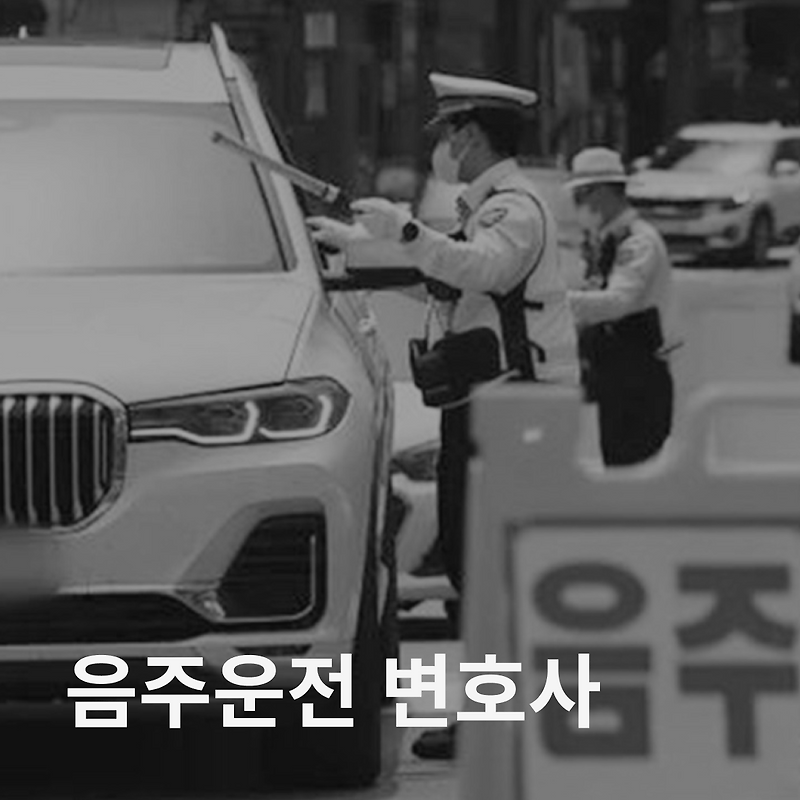
When the police lawfully request a breathalyzer test, the driver must comply. If the driver refuses despite being asked several times to take the test, then even in a case of simple drunk driving, they may face imprisonment of one to five years or a criminal fine of KRW 5 million to KRW 20 million.
Police officers in charge of breathalyzer testing record the situation with a body camera in anticipation of a refusal. If a driver refuses even though the officer lawfully requested the test, the footage recorded on the body camera can be used as evidence, and the charge of refusing a breathalyzer test may be upheld.
Sometimes, while intoxicated, a person feels that the officer's request for a breathalyzer test is unjustified. I myself have argued for acquittal in cases of refusing a breathalyzer test on this very basis. However, when you examine the evidentiary record during trial, it often turns out that the client's fault is actually even more clearly revealed.
Of course, there are also cases where a person, unable to breathe normally due to intoxication, cannot complete the breathalyzer test, and this is treated as a refusal. In such cases, there is a possibility of obtaining an acquittal by arguing at trial that the measurement was genuinely difficult. However, such cases are extremely rare. Therefore, when asked to take a breathalyzer test, it is important to comply as cooperatively as possible. If taking the test is difficult for health reasons such as a respiratory illness, you need to clearly state this so that the difficulty of testing is recorded.
In conclusion, obtaining an acquittal in connection with refusing a breathalyzer test is extremely difficult. Therefore, please be sure to comply with the police's request for a breathalyzer test.
License Suspension
If your blood alcohol concentration is 0.03% or higher but below 0.08%, you will receive a suspension of your driver's license and a criminal fine of up to KRW 5 million.
License Revocation Due to Drunk Driving
When you receive a license revocation disposition due to drunk driving, the disqualification period varies depending on your blood alcohol concentration and the type of accident.
First, for simple drunk driving with a blood alcohol concentration of 0.08% or higher, for cases with a blood alcohol concentration below 0.08% that caused property damage, and for cases of refusing a breathalyzer test, the license revocation disqualification period is one year.
Next, for drunk driving with a blood alcohol concentration of 0.08% or higher that caused personal injury or property damage, or for being caught for simple drunk driving two or more times, the license revocation disqualification period is two years.
In addition, for cases involving drunk driving and refusal of a breathalyzer test that resulted in two or more drunk driving traffic accidents, the license revocation disqualification period is three years.
For causing an accident involving personal injury and then fleeing, the license revocation disqualification period is four years.
Lastly, for causing an accident involving personal injury while drunk driving and then fleeing, or for causing a traffic accident through drunk driving that results in the victim's death, the license revocation disqualification period is five years.
As shown above, the license revocation disqualification period for drunk driving is applied differently depending on the degree of intoxication and the severity of the accident.
When a license is revoked due to drunk driving, the requirements for obtaining relief are very demanding. First, none of the grounds set out in Item 1(f) of Annexed Table 28 of the Enforcement Rules of the Road Traffic Act may apply. These grounds include driving with a blood alcohol concentration exceeding 0.1%, causing a traffic accident involving personal injury while drunk driving, failing to comply with or fleeing from an officer's request for a breathalyzer test, or assaulting the officer conducting the enforcement. If even one of these applies, there is almost no possibility of obtaining relief. The administrative and judicial bodies that handle these matters take the criminal responsibility for drunk driving very seriously, and they do not recognize any need for relief in such serious cases.
Second, the applicant for relief must clearly demonstrate that the administrative agency's license revocation disposition is excessively harsh. This applies where the disposition could have a serious impact on the applicant's livelihood or social standing. In the past, the Central Administrative Appeals Commission would sometimes change a license revocation disposition into a suspension disposition in such situations, but recently, as public awareness has grown, there has been a demand for strict enforcement of the law against drunk driving. As a reason that those who drive should never drink and drive, decisions denying relief have become more common in reality.
Therefore, when a license is revoked due to drunk driving, the requirements for obtaining relief are very demanding, and they are becoming increasingly difficult in line with current social trends.